Heritage · The modern country
A short history of Malawi.
Missionaries and empire, a rising in 1915, a hard road to independence, three decades of one-party rule and a democratic turn in 1994.
Before the British
Kingdoms, trade and migration.
Long before European maps, the region held the Maravi confederation and its successor chiefdoms. To the north lived the Tumbuka; around the lake, the Yao built a trading network that reached the Swahili coast and carried Islam with it; from the 1830s and 1840s, Ngoni groups migrating from southern Africa arrived in the highlands.
These were not isolated societies. They traded salt, iron, cloth, ivory and — increasingly, and tragically — people. The nineteenth-century slave trade from the lake region to the coast is one of the reasons missionary intervention was able to attract support in Britain.
Livingstone and the missions
1859: a Scottish explorer reaches the lake.
David Livingstone reached Lake Malawi in September 1859 during his Zambezi expedition. His reports of the lake, the slave trade and the possibilities of commerce and Christianity shaped British interest in the region for the next thirty years.
The Universities’ Mission to Central Africa arrived in 1861 and established a station at Magomero; its first bishop, Charles Mackenzie, died of fever in 1862 and the mission withdrew to Zanzibar. Scottish Presbyterian missions followed, and their influence — educational, linguistic and commercial — remained long after.
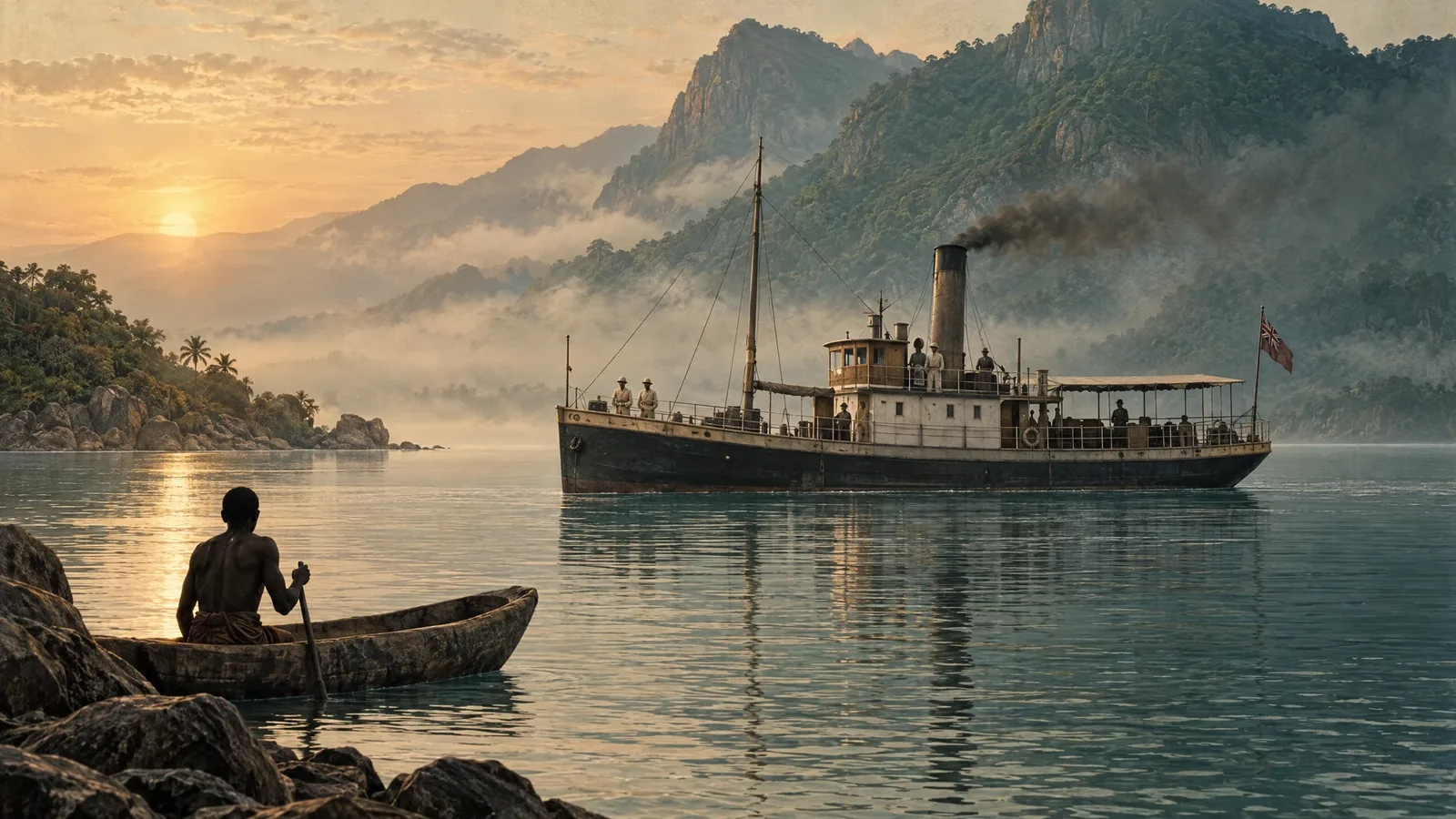
Around the missions came traders, including the African Lakes Company, founded in 1878 to open the rivers and lakes to legitimate commerce. Its steamers and supply line became the backbone of the colonial economy.
Nyasaland
A protectorate, and a rising.
In 1891 Britain declared the Nyasaland Districts Protectorate; in 1893 it became the British Central Africa Protectorate, and in 1907 it took the name Nyasaland. Land was alienated to European estates in the fertile southern highlands, and Africans were taxed in cash — which meant working for wages or growing cash crops.
On 23 January 1915, the Reverend John Chilembwe led an uprising against colonial rule and the conditions of African labour, attacking estates in the Shire Highlands. He was killed on 3 February. The rising failed, but it became the founding act of Malawian nationalism; Chilembwe’s face appears on the country’s banknotes.
Coffee, tea and tobacco built the southern estate economy — and the porters, railways and river steamers described on our coffee page were built to move those crops to the coast.
Independence
Federation, emergency, freedom.
In 1944 the Nyasaland African Congress was formed. In 1953 Britain forced Nyasaland into the Federation of Rhodesia and Nyasaland with Southern and Northern Rhodesia — deeply unpopular in Nyasaland, where it was seen as a device to entrench white settler rule.
In March 1959 a state of emergency was declared and Congress leaders were detained. The Devlin Commission, sent to investigate, described Nyasaland as a “police state” — a phrase that caused a political storm in London and helped change the argument.
Hastings Kamuzu Banda returned to lead the campaign. The federation was dissolved at the end of 1963, and Malawi became independent on 6 July 1964. Two years later it became a republic with Banda as president; in 1971 he was made president for life.
Democracy
1992, 1993, 1994.
Banda’s rule brought stability and severe political repression. In March 1992 a pastoral letter from Malawi’s Catholic bishops criticised the government’s human-rights record and was read from pulpits across the country; it became a turning point.
A referendum in June 1993 rejected the one-party system with about 63 per cent of the vote. In May 1994 Bakili Muluzi won the first multi-party election, and Malawi has held competitive elections ever since — with all the contention, and all the resilience, that implies.
Malawi today
A young country with an old story.
Malawi today is young — most of its people are under twenty-five — and overwhelmingly agricultural. Tobacco remains the largest export earner, followed by tea, sugar and other crops; coffee is small by comparison but significant for the growers who depend on it.
The country has faced repeated shocks: drought and cyclones, foreign-exchange shortages, fuel and fertiliser costs. It has also kept a democratic habit that many neighbours have lost, and a reputation for warmth that visitors remark on immediately.
For a business carrying the country’s old name, that is the context worth understanding: not a postcard, and not a tragedy, but a place with a long history and a great deal still to build.
The crop
And then there is coffee.
The plant that arrived in the 1870s, was carried to the coast on foot, and nearly disappeared.