01
Cherry to green bean
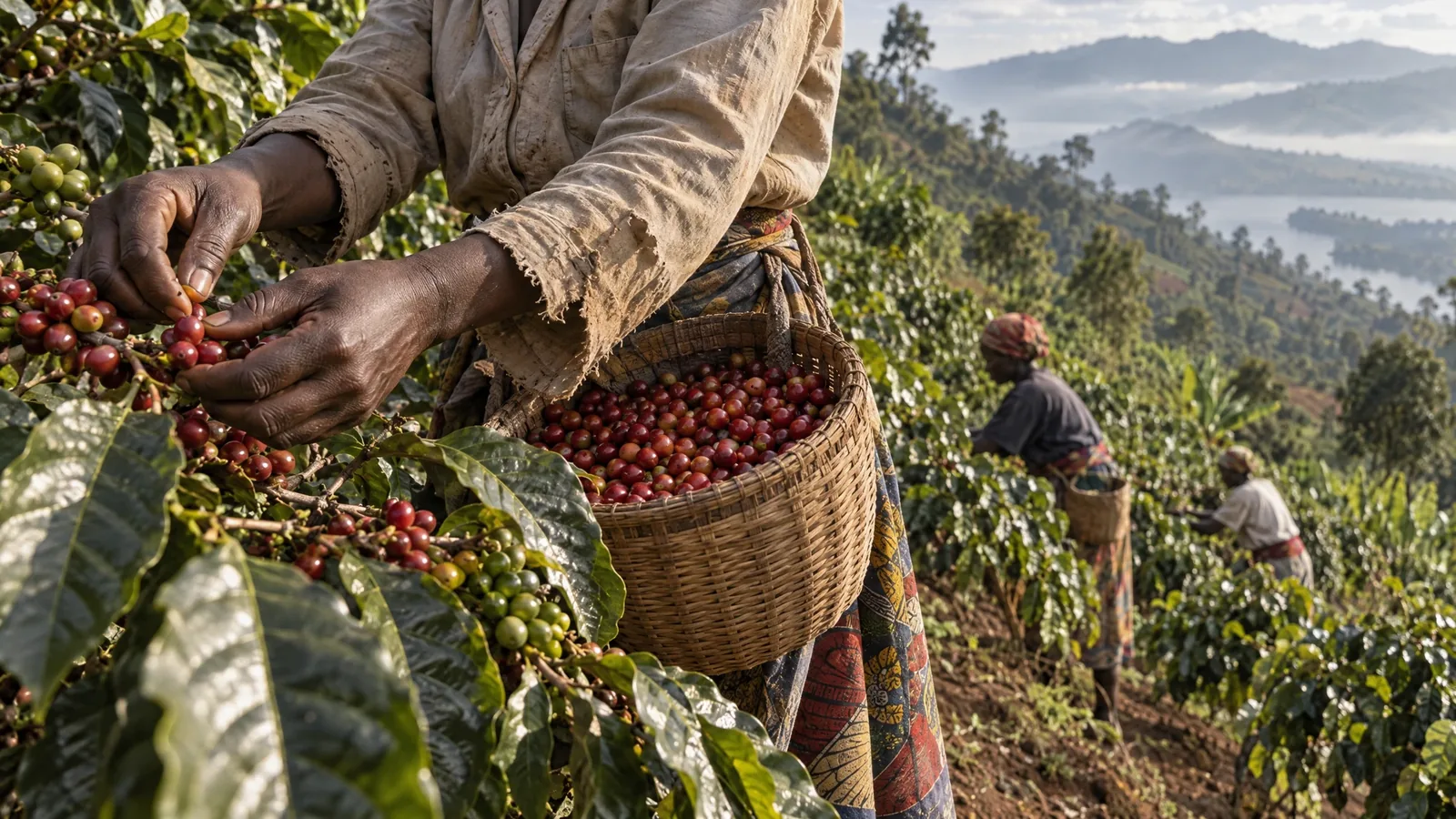
Ripe cherries are picked, pulped, fermented, washed and dried on beds to parchment, then milled to green coffee for export.
Heritage · The crop
Before the railway, Malawian coffee went to the coast one forty- or sixty-pound load at a time. The story of the crop is mostly the story of the people who moved it and grew it.
Arrival
The family’s account is that coffee came to Malawi from Edinburgh in 1870, and that by the late 1880s it was being shipped to the British Empire. It is a story told with confidence and without footnotes, and it has the shape of the truth.
The documentary record is close but not identical. World Coffee Research dates the arrival of Typica coffee from Jamaica to 1878 and describes a flourishing industry by 1891. Sucafina credits missionaries in the 1880s. Perfect Daily Grind tells of Dr John Buchanan bringing the “Nyasaland” variety from Edinburgh’s Royal Botanic Gardens in the late nineteenth century — which is, in essence, the family’s story with a slightly later date.
So: a Scottish botanic garden, a plant that suited the highlands, and a crop that was being exported before the railway arrived. Whether the year was 1870 or 1878 matters less than what happened next.
The hard road
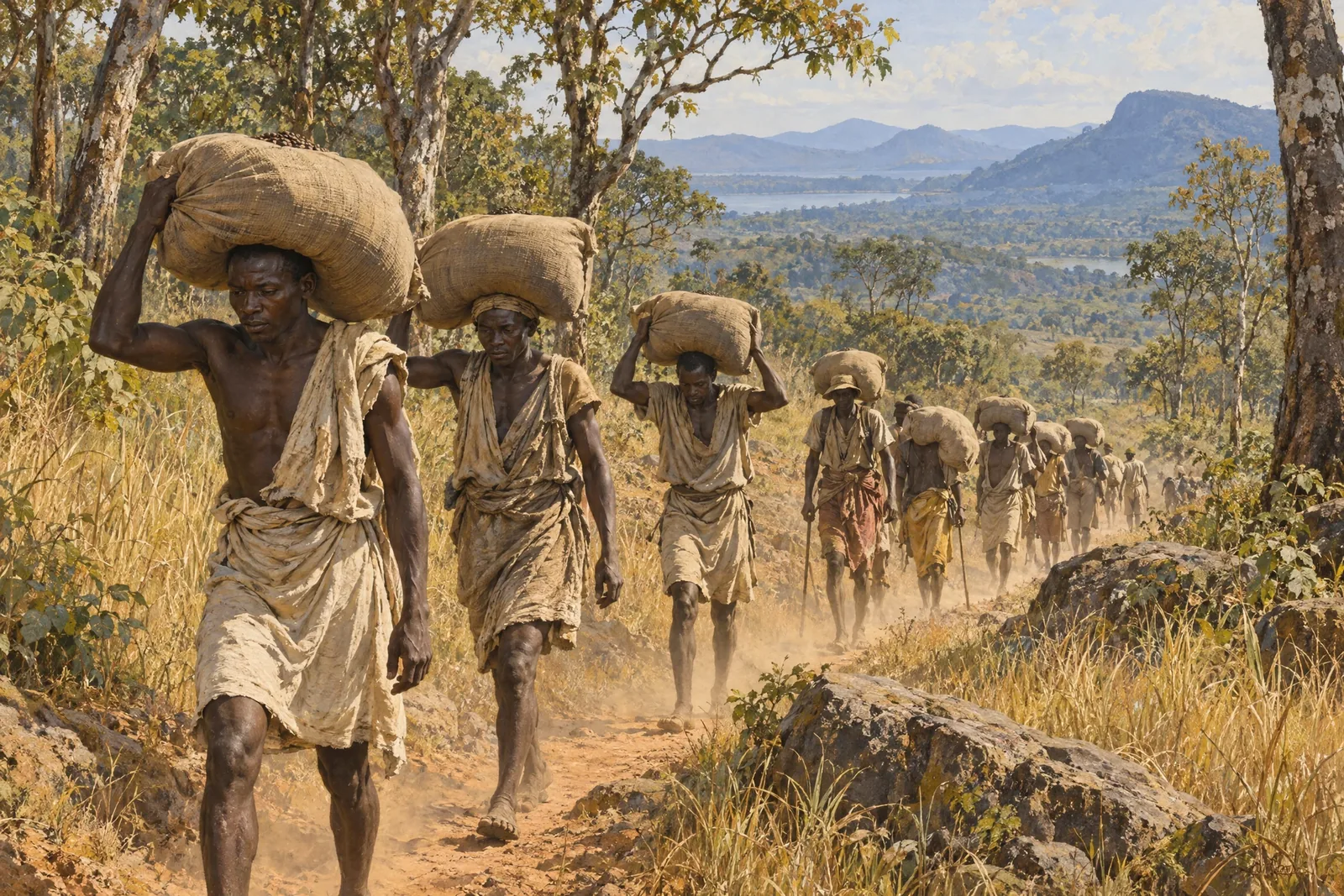
For the first decades of the export trade there was no railway and no road worth the name. Coffee moved on people. Porters carried loads of forty to sixty pounds from the highlands to the Shire, and the records of the time describe a journey measured in days, seasons and loss.
A carrier taking a sixty-pound load from Katunga to Blantyre — twenty-six miles, with a three-thousand-foot climb — earned ninepence. In 1900 an estimated eighty thousand porters were needed to keep goods moving; in November of that year a hundred thousand loads were said to be waiting at Katunga, some of them more than a year old.
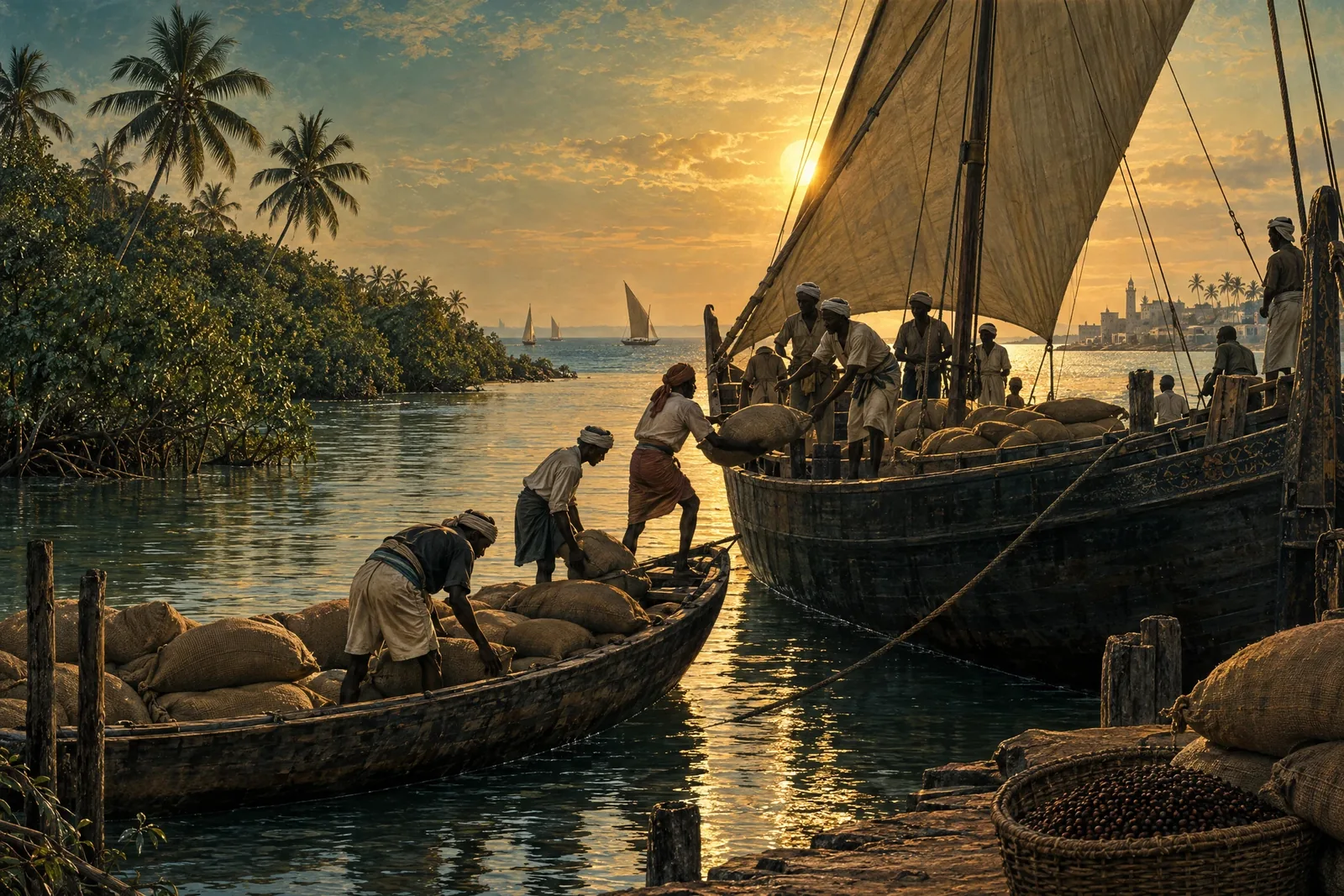
Then the river: shallow-draught paddle steamers and barges down the Shire and the Zambezi, transhipping at Chinde or Chindio, and finally coastal vessels to Beira or Quelimane. The African Lakes Company’s own shareholders were told in 1898 that falling rivers forced repeated transhipment and that “the human cost was considerable too: many of the carriers died”.
The family remembers the last leg as dhows waiting at the coast, and a dhow called Sumlii among them. Shipping records of the period dwell on steamers, barges and lighters; the dhows were the older, quieter layer of the same trade. That memory is where this company’s name comes from.
Collapse
Coffee’s first boom did not last. Exports fell to about 122,000 pounds in 1918, and the area under coffee in Nyasaland dropped from more than eight thousand acres in 1903 to around twelve hundred by 1917. Marginal climates, pests, overbearing trees and the rise of tobacco and tea all played a part.
Rail reached Blantyre from Chiromo in 1907–08 and the Zambezi in 1914, ending the porterage — but freight remained expensive, with three transhipments and two to three weeks from Blantyre to the sea. Not until the Trans-Zambezia Railway in 1922 and the Dona Ana bridge in 1935 was there a through route to Beira.
Smallholder coffee was reorganised under the Smallholder Coffee Authority, founded in 1971 (Mzuzu Coffee dates its operations from 1979). It provided extension and input loans, but it was profitable in only two years of its life, and by 1999 it owed forty million kwacha while growers received just 20 to 30 per cent of the sale price. Many uprooted their trees in despair.
Then came coffee wilt disease. Outbreaks through the 1980s and 1990s nearly wiped out smallholder cultivation, with a severe episode in 1990–91. The disease has cost African growers an estimated billion dollars.
Rebuilding
In 1999 the farmers abolished the Authority and formed the Smallholder Coffee Farmers Trust, with farmer trustees and shareholding. A mass replanting programme followed, using Catimor — fast-maturing, wilt-resistant, and cropping within about three years — largely replacing Caturra between 1999 and 2007.
The trust became the Mzuzu Coffee Planters Co-operative Union. Sources disagree about the date — 1999, 2006 and 1 April 2007 all appear — which is itself a comment on how much institutional history in Malawi depends on who is telling it. What is not disputed is the effect: growers’ share of the sale price rose from 20–30 per cent to around 70 per cent, and in some years 70–80 per cent.
The union now represents six primary societies and roughly 2,500 to 3,000 members, a quarter of them women, with dozens of washing stations, a cupping lab and a women’s coffee line. Estates still produce around two-thirds of the national crop; the co-operatives produce the rest, and most of the specialty lots.
Today
Malawi produces somewhere between one and two thousand tonnes of coffee a year, from around 3,500 hectares. That is tiny: a rounding error in global terms, and a fraction of the 7,000 to 15,000 tonnes the country produced in earlier decades. Most of it is exported as green bean, mainly to Germany, the Netherlands, the United States, South Africa, Japan and Taiwan.
The difficulties are structural. Trees are old and yields low. Inputs are expensive and often out of reach. Landlocked transport can account for a startling share of the landed cost. Macadamia, tobacco and tea pay better for the same land and labour. In a 2023 survey of five co-operatives, pests and diseases ranked first among growers’ problems, followed by inadequate inputs and unstable markets.
The opportunities are equally clear. Malawi grows Geisha, the variety that made its name in Panama, along with Nyika, Catimor and others, and its best washed lots score well with specialty buyers. Since 2017 the country has hosted an International Multilocation Variety Trial with World Coffee Research and the Department of Agricultural Research Services — twenty-eight varieties planted at Lunyangwa, first harvested in 2021, cupped with Mzuzu in 2022.
A national coffee strategy for 2025 to 2040 sets a target of 50,000 hectares and yields of a tonne or more per hectare. It is ambitious. It is also the first time in decades that the sector has had a plan with money and institutions behind it.
The cup
Washed Malawian arabica is usually described as sweet and delicate, with floral notes and a spice or liquorice edge rather than heavy fruit. The best Geisha lots are fragrant and tea-like; the everyday coffee is clean and balanced, and easy to like without explanation.
Malawi also grows a little robusta, so it is not quite true to say the country is arabica-only — although the specialty trade is entirely arabica. Most coffee is fully washed; some estates experiment with natural, honey and anaerobic fermentation.
01
Ripe cherries are picked, pulped, fermented, washed and dried on beds to parchment, then milled to green coffee for export.
02
Washed coffees have the fruit removed before drying and taste cleaner; naturals dry inside the cherry and taste sweeter and fruitier.
03
A microlot is a small, traceable lot kept separate; cupping is the professional tasting that decides where it goes.
Maravi’s part
Because the growers are the beginning of the supply chain, and a café is the end of it. The more Malawian coffee is roasted, served and talked about in Britain and Spain, the more demand exists for the crop at the other end — and demand that pays properly is the only thing that keeps a farmer planting coffee rather than macadamia.
Maravi roasts Malawian coffee in Dorset and sells a range including Geisha microlots. SUMLII’s job is to carry that further: more countries, more cafés, more people asking where the coffee came from.
It is a commercial relationship, not a charity. But it is the kind of commercial relationship that a country with a famous name and a difficult history can actually use.
Further reading
Figures differ between sources and years. Where they do, this page gives a range or attributes the figure rather than pretending there is one number.
From the archive
Films from the co-operatives and estates, including a walk through a Mzuzu coffee farm.